


A nursing student struggling with her "Which Client Do You See First?" practice questions.
You know the content. You've passed your exams. Then a practice question asks, "Which client should the nurse assess first?" and all four answers look like they could be right.
So you guess. You get it wrong. And you start wondering if you're just not NCLEX material.
You are. But I need to tell you what's really happening, because it will change how you study.
Let’s dive in!
This isn't a side topic. It's the biggest slice of the exam.
Management of Care, the category that covers prioritizing, delegating, and supervising, carries the highest share of questions in the NCLEX-RN test plan. One NCLEX prep source summarizing the plan puts it at 17-23% of the exam, and lists establishing priorities and assignment, delegation, and supervision among its core areas (McDonough, n.d.). The National Council of State Boards of Nursing (NCSBN) publishes the official breakdown itself, so check the current version before you build your study plan (NCSBN, 2016). The plan has been updated since 2016, so confirm the latest version at ncsbn.org.
Translation: if you're studying disease by disease and skipping prioritization practice, you're ignoring the part of the exam that shows up the most.

A student looking through his missed questions.
Why smart students miss these questions.
Because prioritization isn't recall. Every answer option is usually a real nursing action that is true and important. The exam isn't asking "what's correct?" It's asking "what matters most, right now, for this patient?"
That is a clinical judgment skill. In NCSBN's Clinical Judgment Measurement Model, it's the step where you prioritize hypotheses, after you've recognized and analyzed cues and before you generate solutions and take action (Clinical Judgement and Test Taking Strategies, n.d.). Students who jump from "I see the cues" straight to "pick an answer" skip the step the question is actually testing.
A three-question filter you can use every time.
When you hit a "first" or "priority" question, stop and ask:
What's the most unstable? Think airway, breathing, circulation, and new or sudden changes before chronic, expected, or stable problems. A new change in a stable patient often outranks a long-standing issue in a sicker-looking one.
What threatens life before limb, whole body before one part? A systemic problem beats a local one, and acute beats chronic.
Whose job is this? If the question involves assigning care, ask whether the task needs assessment, teaching, evaluation, or nursing judgment. Those stay with the RN. Stable, predictable, routine tasks can often go to others, depending on scope of practice.
Notice what's missing: memorizing a list of "always do this first." Rules help, but they break the moment a question is built to make them conflict. The filter works because it makes you reason.
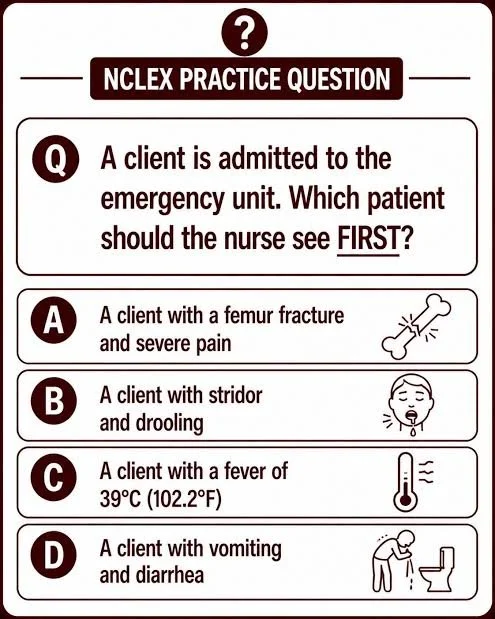
An example of a "Which Client Do You See First?" question.
The trap: ABCs aren't the whole answer.
ABCs are a great start. But if every priority question gets answered with "airway!", you'll miss the ones where the airway is fine and the real priority is the post-op client with a quiet, subtle change in status. Use ABCs to begin your thinking, not end it.
How to practice (this week).
Do 10 priority or delegation questions a day, and don't just check the answer. Write one sentence: "This one is first because ___."
When you miss one, name which step failed: did you miss the cue, misjudge urgency, or forget who can do the task?
Then redo it a day later without looking.
That sentence is the whole skill. If you can say why, you'll get the next question you've never seen.
The bottom line
You don't need to know more. You need to decide what matters most, faster and with a reason. That's not a test trick. It's exactly what you'll do on your first shift, with a real patient in the bed.
Want help turning this into a habit? Respond with "ACCELERATOR" and I'll get you the help to learn it.: oneononetips.com.
Sources:
Clinical judgement and test taking strategies [Presentation slides]. (n.d.). Scribd. https://www.scribd.com/presentation/640126080/Untitled
McDonough, D. S. (n.d.). NCLEX®: Understanding the management of care category. Hurst Review. https://www.hurstreview.com/blog/nclex-understanding-the-management-of-care-category
National Council of State Boards of Nursing. (2016). NCLEX-RN® examination test plan for the National Council Licensure Examination for Registered Nurses (effective April 2016). https://www.ncsbn.org/public-files/RN_Test_Plan_2016_Final.pdf

Coffee with Rhoda

Comment below!
💬 Join the Conversation:
Share your stories in the comments or reach out—I’d love to hear from you.
Do you need help with "Which Client Do You See First?" questions?

Follow and Like!
💙If you are not on our email list, click the contact link here.
💙Don’t forget to follow me on my Instagram account @nclex_one_on_one_tutoring and share it with your colleagues!
💙Join the Facebook Group: One on one tips NCLEX and New nurses
Want Mentorship?

Nurse Mentor
If you’re a new nurse (or an experienced one) who wants help building communication skills, I’m here to support you.
Let’s imagine a nursing culture where we handle conflict with courage, professionalism, and care—not fear or silence.
Let’s build that together.

