


A new nurse wondering how to make the call.
It's 2:40 in the afternoon. Your patient's pressure is drifting, they just don't look right, and every instinct you have says call someone.
Then the second voice shows up: What if I'm wrong? What if I sound ridiculous? What if they're annoyed?
After 40 years in nursing, I can tell you this: the nurse who hesitates is not the nurse who lacks knowledge. She's the nurse who was never taught what to say. Nobody hands new grads a script for the hardest 30 seconds of the job.
So let's fix that.
Let’s dive in!
The problem isn't your brain. It's the hierarchy.
Patient safety experts have a name for the hesitation you feel: the authority gradient. One safety write-up describes an ICU with no standard way for nurses and providers to communicate, which led to information that was incomplete, inaccurate, or late when concerns were escalated. The same piece argues that being willing to challenge hierarchy and communicate assertively is a core part of good teamwork (Patient Safety Solutions, 2022).
Translation: when a call goes badly, it's usually a system and structure problem before it's a you problem. Structure is something you can learn this week.
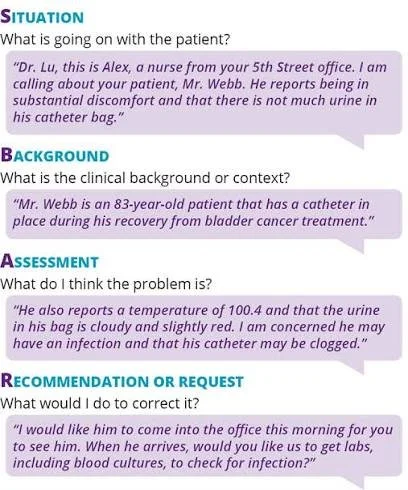
SBAR
Use SBAR. Out loud. Before you pick up the phone.
SBAR (Situation, Background, Assessment, Recommendation) is the tool most hospitals already hand you. Oncology nurses who adopted it noted that it is especially helpful for new graduates who don't yet know how the hospital works and may feel intimidated by physicians (Cancer Network, n.d.). The format has even been tested in randomized simulation of after-hours nurse-physician phone calls (AHRQ Patient Safety Network, n.d.).
Here's what it sounds like in real life:
S: "Dr. Patel, this is Rhoda on 4 West. I'm calling about Mr. Jones in 412. His systolic has dropped from 128 to 92 in two hours."
B: "He's post-op day one from a bowel resection. He's had 30 mL/hr urine output for the last two hours."
A: "He's pale, HR 118, and his abdomen is more distended than this morning. I'm worried he's bleeding or going septic."
R: "I'd like you to come see him now. Do you want labs or fluids started while you're on the way?"
That's under 30 seconds. No apology. No "sorry to bother you."
Don't skip the R, even when it feels bold.
Here's something honest from the research. In a study of SBAR in a Midwestern ICU, nurses agreed SBAR should be taught to all new nurses, but both nurses and physicians felt the Recommendation step came across as overly assertive (Gerard, 2011).
So the R is the step everybody flinches at. Practice it anyway. Soften the delivery if you need to ("What would you like me to do?" works), but never leave the call without a plan or a time you'll update them again. A recommendation shows you've done your thinking. That's not arrogance, that's clinical judgment.

New nurses calling the doctor.
Have your "I'm not comfortable" line ready.
Sometimes you call, and the answer doesn't match what you're seeing. That's when a phrase you've already rehearsed saves you. Escalation language commonly taught to nurses includes plain statements like "I'm concerned about this patient's condition" and "I'm uncomfortable with this approach" (Passport USA, n.d.). One patient safety write-up names the CUSS tool as a structured way to escalate assertively (Patient Safety Solutions, 2022). Learn your hospital's chain of command before you need it, and use it without guilt.
Practice makes the call easier.
In one simulation project for novice inpatient nurses, 92% reported feeling comfortable communicating with the physician using the SBAR template afterward (Advocate Aurora Health, 2024). Confidence isn't a personality trait. It's a rep count.
Try this tonight: write an SBAR for your hardest patient this week. Say it out loud. Then say it to a mentor or a charge nurse and ask, "Would you have acted on that?"
The bottom line
A late call is almost never forgiven faster than an early one. The patient doesn't care if you were nervous. Make the call, say it clearly, and ask for what you need.
Need someone to run your SBARs by before the real call? That's exactly what one-on-one mentoring is for. Respond with "SURVIVAL" and I'll get you the help to learn it.
Need help making the call? Let's talk: oneononetips.com.
Sources:
Advocate Aurora Health. (2024). [Conference abstract on SBAR simulation for novice inpatient nurses]. Nursing Conference 2024, Institutional Repository. https://institutionalrepository.aah.org/nursing_conference/2024/profdev/6
AHRQ Patient Safety Network. (n.d.). Evaluation of a problem-specific SBAR tool to improve after-hours nurse-physician phone communication: A randomized trial. https://psnet.ahrq.gov/issue/evaluation-problem-specific-sbar-tool-improve-after-hours-nurse-physician-phone-communication
Cancer Network. (n.d.). Communication tool empowers nurses, boosts patient safety. https://www.cancernetwork.com/view/communication-tool-empowers-nurses-boosts-pt-safety
Gerard, J. C. (2011). The effect of a communication protocol implementation on nurse/physician collaboration and communication (Electronic Theses and Dissertations, Paper 487). University of Louisville. https://doi.org/10.18297/etd/487
Passport USA. (n.d.). Confidently contacting physicians for orders: A guide for nurses. https://www.passportusa.com/resources/5hccdocordusxyz-38a
Patient Safety Solutions. (2022, June 7). SBAR to the rescue. Patient Safety Tip of the Week. https://www.patientsafetysolutions.com/docs/June_7_2022_SBAR_to_the_Rescue.htm

Coffee with Rhoda

Comment below!
💬 Join the Conversation:
Share your stories in the comments or reach out—I’d love to hear from you.
Do you need help making the call?

Follow and Like!
💙If you are not on our email list, click the contact link here.
💙Don’t forget to follow me on my Instagram account @nclex_one_on_one_tutoring and share it with your colleagues!
💙Join the Facebook Group: One on one tips NCLEX and New nurses
Want Mentorship?

Nurse Mentor
If you’re a new nurse (or an experienced one) who wants help building communication skills, I’m here to support you.
Let’s imagine a nursing culture where we handle conflict with courage, professionalism, and care—not fear or silence.
Let’s build that together.

