

The NCLEX Isn’t Testing What You Memorized—Priority Method Part 2

The Priority Method
A Different Way to Approach Every Question
Over the years, I've found myself teaching students the same thought process over and over again.
Instead of guessing...
Instead of jumping to the first answer that looks familiar...
I teach them to slow down, read the entire question, and work through the situation one step at a time.
I call it the PRIORITY Method.
Today, I'd like to introduce you to the next three steps.
Let’s dive in!
The PRIORITY Method: Options, Respond & Inspect
Last week, we started looking at NCLEX questions a little differently.
Instead of asking,
“Do I remember the right answer?”
I asked you to start thinking:
“What story is this patient telling me?”
Using the first three steps of the PRIORITY Method, we learned to:
P – Perceive: What am I noticing?
R – Relate: How do these cues fit together?
I – Identify: What requires my attention first?
But identifying the priority is only part of clinical judgment.
Once you know what is happening with your patient, the next question becomes:
What are you going to do about it?
That brings us to the next three steps of the PRIORITY Method:
O – Options
R – Respond
I – Inspect
And we're going back to the same patient we met last week.
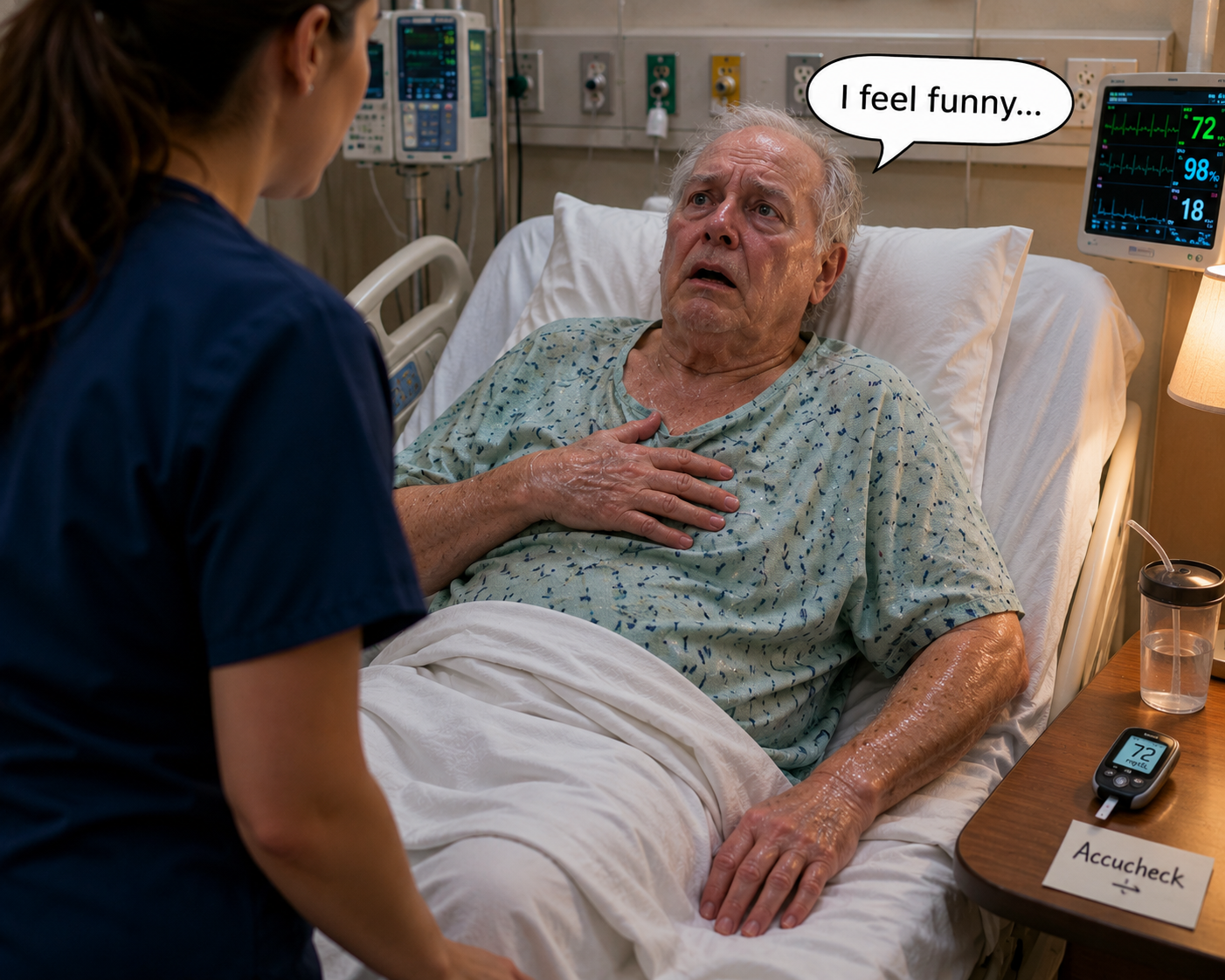
A new nurse checking on her patient.
Let's Go Back Into the Patient's Room
Our patient is 72 years old and was admitted with pneumonia.
When you entered the room, the patient was sitting upright, pale and anxious, and told you:
"I can't seem to catch my breath."
Your assessment showed:
Respiratory rate: 30 breaths/minute
Heart rate: 118 beats/minute
Blood pressure: 90/58 mmHg
Oxygen saturation: 88% on room air
Temperature: 101.8°F (38.8°C)
Last week, we Perceived the clues.
We Related them to one another.
Then we Identified the immediate priority:
This patient's oxygenation and respiratory status are worsening.
Now what?
This is where many NCLEX students get into trouble.
They know something is wrong, but then they see four answer choices that all sound like reasonable nursing actions.
So how do you choose?
O – Options
Options means considering the safe, appropriate actions available to address the priority problem you have identified.
Ask yourself:
“What could I safely do for this patient?”
Notice I said could.
At this stage, you're not necessarily choosing your final answer yet.
You're considering your possibilities.
For this patient, your options might include:
Positioning the patient upright to improve lung expansion.
Applying oxygen according to orders or protocol.
Performing a focused respiratory assessment.
Checking lung sounds and work of breathing.
Reassessing oxygen saturation.
Notifying the provider or activating additional help based on the patient's condition.
Preparing for additional interventions if the patient's respiratory status continues to decline.
Several actions may be appropriate.
And that's exactly what makes NCLEX questions difficult.
Sometimes the test gives you more than one action that could eventually be done.
Your job is to determine:
Which option matters most right now?
Before choosing an answer, ask yourself:
Does this action address my identified priority?
If your priority is impaired oxygenation, an answer about treating the fever may be appropriate eventually—but it does not address the most immediate threat.
That one question can help you eliminate a lot of tempting NCLEX answers.
R – Respond
Now it's time to act.
Respond means selecting and carrying out the safest, highest-priority nursing action based on the patient's immediate needs.
Ask yourself:
“What should I do first?”
For our patient, oxygen saturation is 88%, respiratory rate is 30, and the patient is visibly struggling to breathe.
The nurse needs to address oxygenation immediately.
Depending on the exact wording of an NCLEX question and the orders or protocols provided, that may mean positioning the patient, applying oxygen, or initiating another immediate nursing intervention while getting additional help.
Here's something important:
The NCLEX is not only asking, “What can a nurse do?”
It's asking:
“What should the nurse do FIRST?”
Those are two very different questions.
Maybe the patient needs an antibiotic.
Maybe the provider needs to be notified.
Maybe a chest x-ray will be ordered.
Maybe labs need to be drawn.
All of those things could become part of the plan.
But your patient is hypoxic now.
Respond to the immediate problem in front of you.
This is where your nursing priorities matter.
Think:
Airway. Breathing. Circulation. Safety.
And don't forget one of the most important things you learned in the first three steps:
Respond to the story the patient is telling you—not simply the diagnosis written in the chart.
I – Inspect
This may be one of the most overlooked parts of an NCLEX question.
You did something.
Great.
But are you finished?
No.
Inspect means reassessing the patient after your intervention to determine whether the action worked and whether the patient's condition is improving, unchanged, or worsening.
Ask yourself:
“Did what I just did help my patient?”
Suppose you reposition the patient and oxygen is initiated.
Now you inspect.
You reassess:
Oxygen saturation
Respiratory rate
Work of breathing
Skin color
Mental status
Heart rate
Blood pressure
The patient's report of how they feel
Maybe the oxygen saturation rises from 88% to 94%.
The patient's respiratory rate drops.
They look less anxious.
And they tell you,
"I can breathe a little easier now."
Those are signs that your intervention is helping.
But what if the oxygen saturation remains 88%?
What if the patient's blood pressure continues to fall?
What if they become confused or difficult to arouse?
Now the story has changed.
Your first intervention was not enough.
You need to reassess your Options and Respond again.
That's nursing.
We don't perform an intervention and walk away assuming it worked.
We assess.
We act.
And then we assess again.

A nurse checking off priority.
See What You Just Did?
Let's look at how far we've come with one patient.
P – Perceive
What am I noticing?
The patient is pale, anxious, tachypneic, tachycardic, hypotensive, febrile, and hypoxic.
R – Relate
How do the cues fit together?
The findings suggest worsening respiratory distress and possible deterioration related to pneumonia.
I – Identify
What requires my attention first?
The patient's impaired oxygenation.
O – Options
What could I safely do?
Consider nursing interventions that directly address oxygenation and respiratory distress.
R – Respond
What should I do first?
Choose the safest action that addresses the immediate problem.
I – Inspect
Did it work?
Reassess the patient and determine whether the intervention improved the condition.
Do you see what's happening?
We're not memorizing six unrelated definitions.
We're following the patient from the moment we walk into the room.
Notice. Connect. Prioritize. Consider. Act. Reassess.
That's clinical judgment.
And that is much closer to what the NCLEX is asking you to do.
Your Turn
Let's change the patient's story just a little.
You initiate the appropriate intervention.
Ten minutes later, you reassess the patient.
Their oxygen saturation is now 86%.
Their respiratory rate has increased to 34 breaths/minute.
They appear increasingly restless.
The patient looks at you and says,
"It's getting harder to breathe."
Don't jump to an answer choice.
Use the method.
What do you notice now?
How do those findings relate?
What has become your priority?
What options do you have?
How should you respond?
And after you respond...
What will you inspect?
That's how I want you to begin thinking through NCLEX questions.
But We're Still Not Finished
We now have six pieces of the PRIORITY Method:
Perceive. Relate. Identify. Options. Respond. Inspect.
There are two more.
And they're important because nurses rarely practice alone.
Sometimes the safest decision is recognizing:
I need help.
And every intervention eventually brings us to another question:
What happened to my patient because of what I did?
Next week, we'll finish the PRIORITY Method with:
T – Team
Y – Yield
And then you'll be able to see the entire process from the first patient clue to the final outcome.

Coffee with Rhoda
☕ Coffee with Rhoda
Here's something I want you to try the next time you answer NCLEX questions.
When you look at the answer choices, don't immediately ask:
“Which answer is right?”
Instead ask:
“Which answer actually responds to the problem I identified?”
That tiny change matters.
Students often choose an answer because it's a correct nursing action.
But the NCLEX isn't always asking you to find a correct action.
It wants the best action for this patient at this moment.
Those words matter:
This patient.
This moment.
You don't have to know everything.
You need to recognize what matters most and know what to do with it.
That's the nurse the NCLEX is looking for.
Reflection Corner
Think about the last NCLEX question you answered incorrectly.
Did you miss it because you didn't know the content?
Or...
Did you begin answering before you gathered all the clues?
Sometimes the difference isn't what you know.
It's how you think through the situation.

You CAN do this!
➡️ Join the Facebook Group [Here] We are aware the link does not work working on getting out a promotion so you can join easily on Facebook
💬 Join the Conversation:

Comment below!
Share your stories in the comments or reach out—I’d love to hear from you.
Think about the last NCLEX question you answered incorrectly.
Did you miss it because you didn't know the content?
Or...
Did you begin answering before you gathered all the clues?

Follow and Like!
💙If you are not on our email list, click the contact link here.
💙Don’t forget to follow me on my Instagram account @nclex_one_on_one_tutoring and share it with your colleagues!
💙Join the Facebook Group: One on one tips NCLEX and New nurses
Want Mentorship?

Nurse Mentor
If you’re a new nurse (or an experienced one) who wants help building communication skills, I’m here to support you.
Let’s imagine a nursing culture where we handle conflict with courage, professionalism, and care—not fear or silence.
Let’s build that together.

