

The NCLEX Isn’t Testing What You Memorized—It’s Testing How You Think
The Priority Method
Introducing the PRIORITY Method: Perceive, Relate & Identify
If you’ve ever finished an NCLEX practice question and thought,
“I knew the content…so why did I get that wrong?”
You’re not alone.
One of the biggest misconceptions about the NCLEX is that it’s simply a test of how much information you can memorize.
Yes, you need to know the content.
But content alone doesn’t answer the question.
The NCLEX is asking something much deeper:
Can you recognize what’s happening with your patient and make a safe nursing decision?
That’s the difference between memorizing facts and thinking like a safe nurse.
Let’s dive in!
It’s Not About Knowing Everything
I’ve worked with students who could list every sign and symptom of heart failure but still struggled to answer an NCLEX question correctly.
Why?
Because they weren’t being asked to list symptoms.
They were being asked:
What are you noticing?
Which findings matter most?
What is the priority?
What should you do first?
That’s a completely different way of thinking.
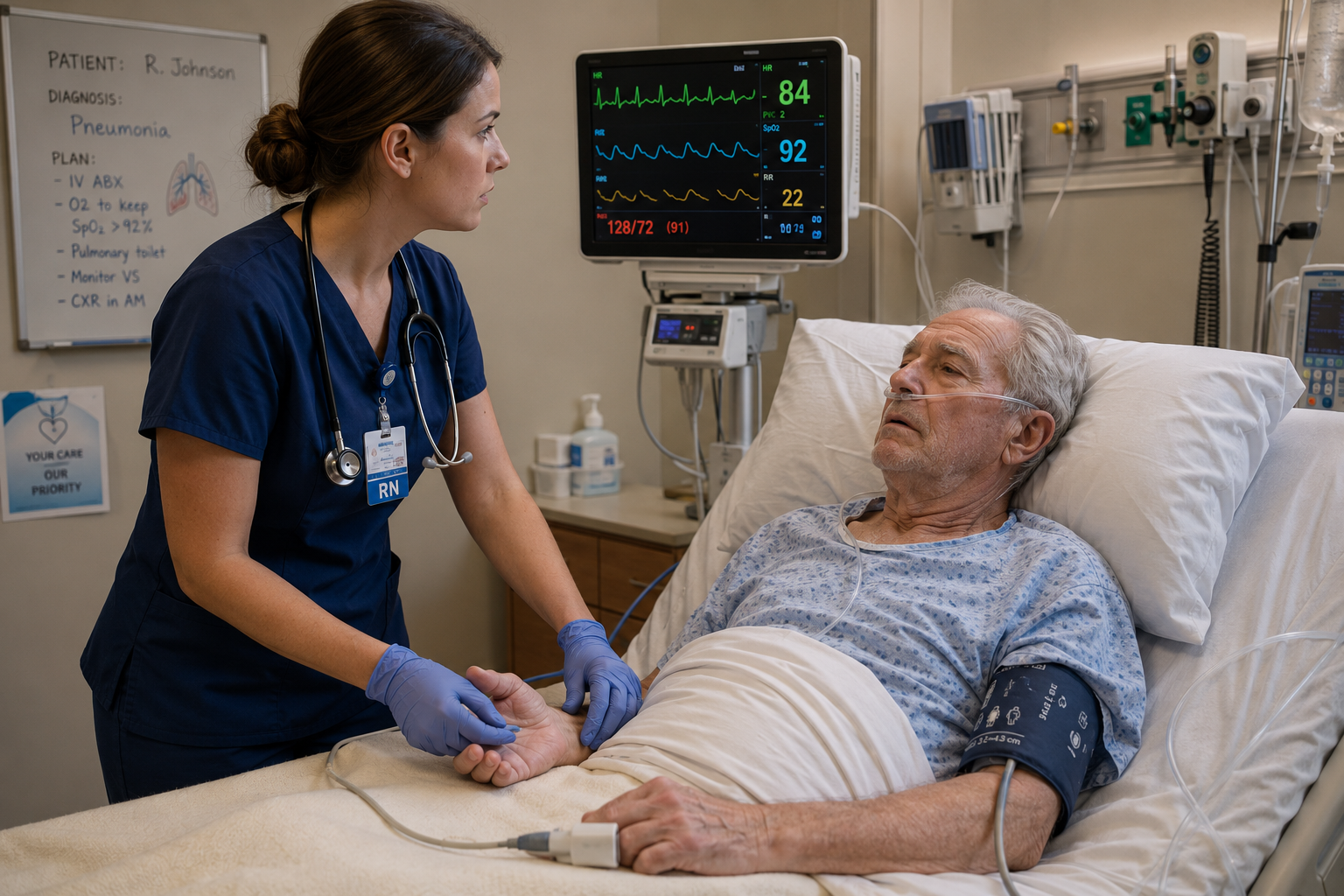
A new nurse checking on her patient.
Let's Walk Through a Patient Together
Instead of jumping straight to the answer, let's slow down and think through this patient together using the PRIORITY Method.
Patient Scenario
You enter the room of a 72-year-old patient admitted with pneumonia.
The patient is sitting upright in bed.
You notice they look pale and anxious.
They tell you,
"I can't seem to catch my breath."
Your assessment reveals:
Respiratory rate: 30 breaths/minute
Heart rate: 118 beats/minute
Blood pressure: 90/58 mmHg
Oxygen saturation: 88% on room air
Temperature: 101.8°F (38.8°C)
Don't skip ahead.
Let's work through it together.
P – Perceive
Perceive means actively noticing and gathering patient cues through observation, assessment, communication, and available clinical data.
Ask yourself:
What am I noticing?
Notice every clue.
The patient says they can't catch their breath.
They appear pale and anxious.
Respiratory rate is elevated.
Heart rate is elevated.
Blood pressure is low.
Oxygen saturation is low.
The patient has a fever.
Don't interpret the information yet.
Simply gather the clues.
R – Relate
Relate means connecting the patient cues to understand how they interact and what they are telling you about the patient's condition.
Ask yourself:
How do these cues fit together?
Instead of seeing seven separate findings...
Notice the story they're telling.
A patient with pneumonia is becoming hypoxic.
Their heart rate is increasing to compensate.
Their blood pressure is beginning to fall.
Their respiratory distress is worsening.
The patient may be deteriorating.
I – Identify
Identify means determining what requires your attention first based on the patient's needs. Sometimes that means deciding which patient is the priority. Other times, it means deciding which problem or intervention comes first.
Ask yourself:
What is my highest priority right now?
Is it the fever?
Is it documenting the assessment?
Is it administering the next scheduled medication?
No.
The immediate priority is the patient's impaired oxygenation and worsening respiratory status.
Now we know what requires our attention first.

A nurse checking off priority.
Your Turn
Before you read next week's blog, stop here for a minute.
Based on what you've learned so far...
What are three nursing actions you could take to help this patient?
Write them down.
Next week, we'll work through the next three steps of the PRIORITY Method—Options, Respond, and Inspect—and see if your thinking matches the process.
This Is Only the Beginning
The PRIORITY Method doesn't stop here.
Over the next several weeks, I'll continue sharing the remaining steps and show you how they work together to help you answer NCLEX questions with greater confidence.
My goal isn't to help you memorize more information.
My goal is to help you think through patient situations the way safe nurses do every day.
Because passing the NCLEX isn't about having every answer memorized.
It's about knowing how to think when the answer isn't obvious.
And that's a skill you'll continue using long after you've passed your exam and started caring for patients.

Coffee with Rhoda
☕ Coffee with Rhoda
Can I give you one piece of advice that has helped hundreds of my students?
Read the entire question before you ever look at the answer choices.
I know it sounds simple.
But I've watched students miss questions they actually knew because they stopped reading after the first sentence.
The NCLEX writers often place the most important clue near the end of the question.
Slow down.
Read every word.
Gather every clue.
Then ask yourself,
"What am I noticing?"
You might be surprised how many more questions you answer correctly.
Reflection Corner
Think about the last NCLEX question you answered incorrectly.
Did you miss it because you didn't know the content?
Or...
Did you begin answering before you gathered all the clues?
Sometimes the difference isn't what you know.
It's how you think through the situation.

You CAN do this!
➡️ Join the Facebook Group [Here] We are aware the link does not work working on getting out a promotion so you can join easily on Facebook
💬 Join the Conversation:

Comment below!
Share your stories in the comments or reach out—I’d love to hear from you.
Think about the last NCLEX question you answered incorrectly.
Did you miss it because you didn't know the content?
Or...
Did you begin answering before you gathered all the clues?

Follow and Like!
💙If you are not on our email list, click the contact link here.
💙Don’t forget to follow me on my Instagram account @nclex_one_on_one_tutoring and share it with your colleagues!
💙Join the Facebook Group: One on one tips NCLEX and New nurses
Want Mentorship?

Nurse Mentor
If you’re a new nurse (or an experienced one) who wants help building communication skills, I’m here to support you.
Let’s imagine a nursing culture where we handle conflict with courage, professionalism, and care—not fear or silence.
Let’s build that together.

