

NGN-Style Questions: What You’re Missing and How to Learn It

Next Generaion NCLEX
Students approach NGN-style questions the same way they approached every test before it: They look for the correct answer.
They read the question.
Scan the options.
And try to recognize what looks right.
Something familiar.
Something they’ve seen before.
Something they remember studying.
And when they don’t see it?
They hesitate.
They second-guess.
They overthink.
Or they guess.
Because they’re still trying to find the answer.
That’s the part no one explains clearly.
Let’s dive in!
It’s Not Asking You What You Think
NGN questions aren’t asking you to find the right answer.
They’re asking you to think through a situation.
And those are not the same thing.
In traditional testing, the answer is often something you recognize.
A lab value
A side effect
A protocol
Something you either know — or don’t.
But NGN-style questions shift that completely.
Now you’re given:
A patient situation
Multiple pieces of information
Sometimes more than one “right” action
And instead of asking:
“What’s the correct answer?”
The question becomes:
“What matters most right now in this situation?”
Why New Students Hesitate
That’s where students get stuck.
Because they’re still trying to match, instead of evaluate.
They look at the options and think: “Which one is correct?”
Instead of asking: “What is this patient telling me?”
That shift is everything.
Because in NGN questions, the answer doesn’t stand alone.
It only makes sense in context.
A response that is correct in one scenario
might be completely wrong in another.
So if you’re trying to memorize your way through these questions, it will always feel inconsistent.
Because the test isn’t measuring memory. It’s measuring judgment.
That’s the part you’re missing.
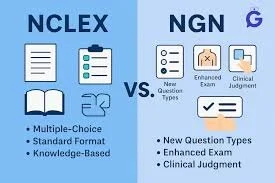
NCLEX vs NGN
Now What Should You Do?
So how do you actually learn this?
You stop starting with the answers, and start with the patient.
Before you even look at the options, ask:
What is happening with this patient?
What is concerning?
What could change quickly?
What matters most right now?
Then — and only then — look at the choices.
Now you’re not searching, you’re confirming.
And that changes how the question feels.
You move from: “I hope I pick the right one…”
To: “This is the direction this patient is going.”
That’s clinical thinking.
The Truth
And here’s the part most people don’t expect: You won’t feel confident right away.
Because this isn’t about memorizing more.
It’s about learning to trust how you process information.
Which takes time, practice, and repetition.
But once it clicks, something shifts.
The questions don’t feel like traps anymore, they feel like scenarios.
And instead of trying to beat the test…You start thinking like the nurse the test is looking for.

You CAN do this!
➡️ Join the Facebook Group [Here] We are aware the link does not work working on getting out a promotion so you can join easily on Facebook
💬 Join the Conversation:

Comment below!
Share your stories in the comments or reach out—I’d love to hear from you.
What’s one thing you tend to look for first — the answer, or the patient?
For seasoned nurses, do you have any tips or advice for other new nurses?

Follow and Like!
💙If you are not on our email list, click the contact link here.
💙Don’t forget to follow me on my Instagram account @nclex_one_on_one_tutoring and share it with your colleagues!
💙Join the Facebook Group: One on one tips NCLEX and New nurses
Want Mentorship?

Nurse Mentor
If you’re a new nurse (or an experienced one) who wants help building communication skills, I’m here to support you.
Let’s imagine a nursing culture where we handle conflict with courage, professionalism, and care—not fear or silence.
Let’s build that together.

